What does it mean to carry a space with you, and to place it somewhere it does not originally belong?
The Open Kitchen has always moved. Long before the Blue House, it took shape in different corners of the city (O-Platz, Gerhart-Hauptmann-Schule, Görlitzer Park, a church community space, a co-working space in Kreuzberg, with the Berliner Obdachlosenhilfe in Wedding) adapting each time to the space and the people around it. In recent years, we found a certain stability through having a place of our own - a room that could hold the kitchen, and us, more consistently. But last summer, with Open Kitchen on the Road, we stepped back into those more nomadic roots. And with that came a familiar question:what does it mean to carry a space with you, and to place it somewhere it does not originally belong?
This question became more tangible when we were invited to host activities at a refugee accommodation at the former Tempelhof Airport. The site, operated by AWO Berlin-Mitte together with Internationaler Bund Berlin-Brandenburg, is the largest accommodation of its kind in Berlin, housing up to 1,596 people. It is a place shaped by transition; marked by a certain in-betweenness that is difficult to fully grasp from the outside.
“In a simple kitchen filled with strangers, it becomes the bridge that connects everyone, gives everyone a purpose and a meaning, and a giant huddle that turns a place into a community.” - Orina
At the Blue House, our work unfolds in a space that we know intimately. We welcome people into something that already exists, something that has its own rhythms, its own familiarity. Entering a space like Tempelhof, however, shifts this dynamic entirely. We are no longer hosts in the same way; we are guests. And with that comes a responsibility to approach more carefully, to listen more closely, and to resist the impulse to simply recreate what we know elsewhere.
Rather than arriving with a fixed structure, we tried to bring only the essentials: food, a shared task, and an openness to what might emerge. Some of our experienced Open Kitchen volunteers from the Blue House hold a light framework, but the space itself remains intentionally unfinished. People can join immediately or stay at a distance, observe, participate briefly, or return later. There is no expectation of how one should take part.
After an initial trial inside the accommodation, we began hosting the sessions at the Fliegerwerkstatt, a project by Social Return Stiftung on the airport grounds. The space offers room for meeting, as well as a wood workshop for young people. Even within this more defined environment, the core question remains present: how to be in a place without taking it over, how to create a space without imposing it.
“I enjoyed most in Tempelhof the automatic solidarity between the people who did not know each other before. The fun with the preparation process with Ukrainian refugees and their willingness to learn very new recipes and their adaptation to the kitchen atmosphere in a second - all of them are unexpected and motivation to do more. Although I could not communicate with them a common language, we managed some way to put something on the table. Food was our language” - Nuran
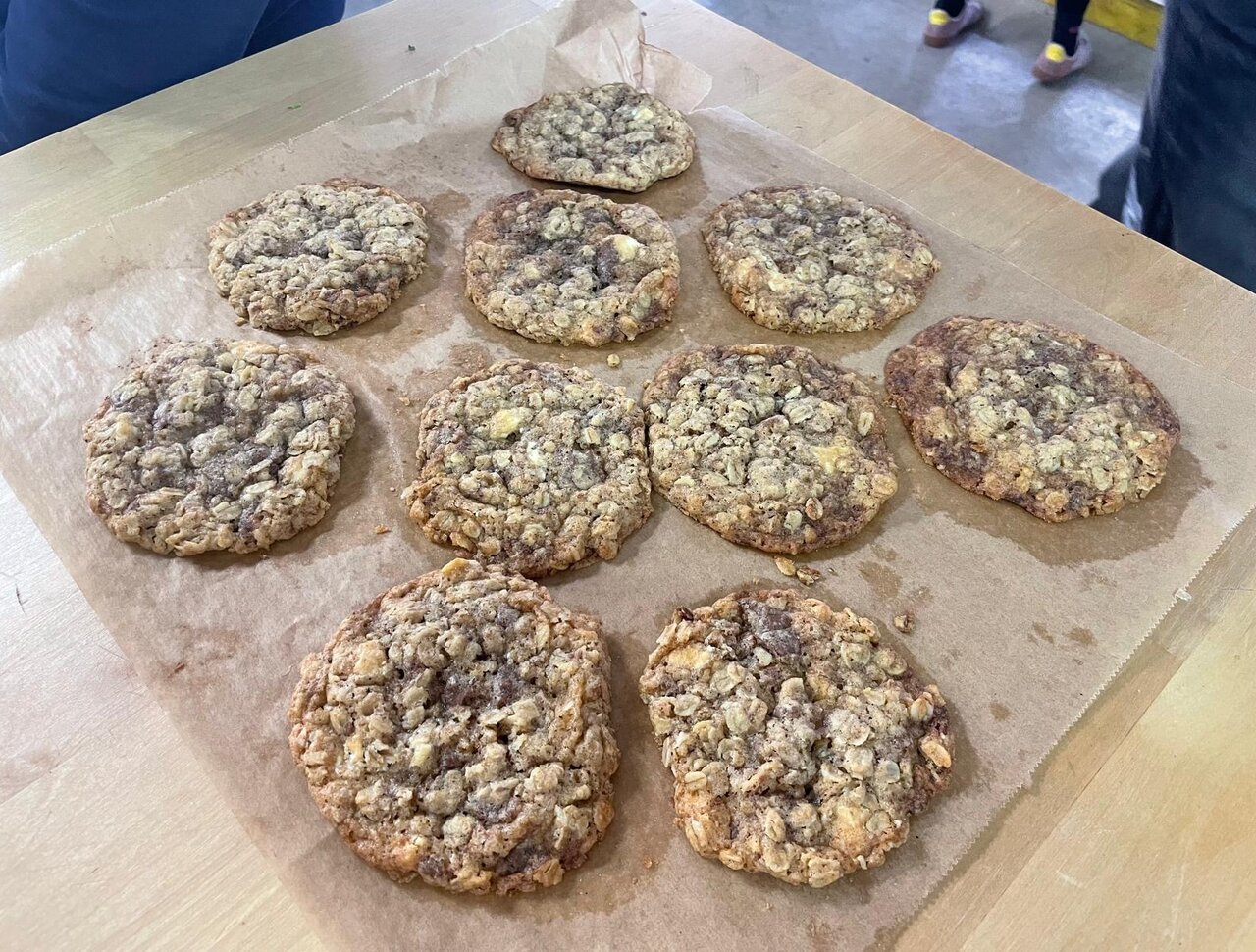
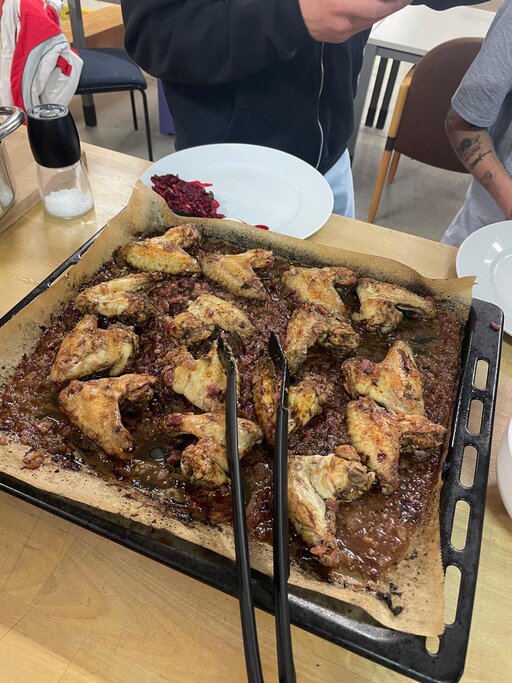
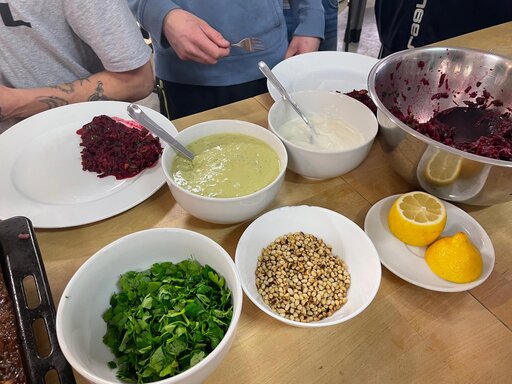
The act of cooking together has become a way of navigating this. On one Saturday, we prepared a simple menu: roast chicken with za’atar, beetroot salad with green tahini, and oatmeal cookies. Language often remains a barrier, but the process of cooking introduces another form of communication. Tasks are shared without much explanation; gestures replace words; attention shifts from speaking to doing. Gradually, a sense of ease begins to form.
What becomes visible in these moments is not only the activity itself, but the conditions that allow people to approach it. When the space is held without pressure or expectation, people tend to move towards it in their own time. This often changes the atmosphere in subtle but significant ways: a hesitation softens, a conversation begins, someone who was watching steps closer and becomes part of the process.
In this sense, the work is not about bringing Open Kitchen to a place, but about creating the conditions in which something can take shape collectively. It requires a different kind of attention. One that is less about leading and more about holding space, less about filling and more about allowing.
"It's been months since I came to Germany, but [the Open Kitchen] is the first place where I can call home with no doubt. At the time, I didn't even have any friends by my side. I've been attending Open Kitchen for not that long but it feels like I never left this place. Here, I am finally at home with this community. Everyone is just so nice and friendly it's hard to stay upset about the world for too long. And with soothing smiles and warm hugs shall we begin our cooking (and eating) sessions :]" - Marin
Our events in Tempelhof are possible thanks to the generous support of the Deutsche Fernsehlotterie. The Deutsche Fernsehlotterie is Germany’s most established social lottery. Together with its players, it supports community welfare. Since 1956, it has generated over €2 billion for charitable causes and, through its foundation Deutsches Hilfswerk, funded around 9,300 projects. In our joint three-year project, we explore how we can offer our activities in other parts of Berlin beyond our home in Neukölln. In doing so, we are not only reaching new communities, but also continuing to learn how to move more thoughtfully within the ones we enter.