
Can you introduce yourself briefly?
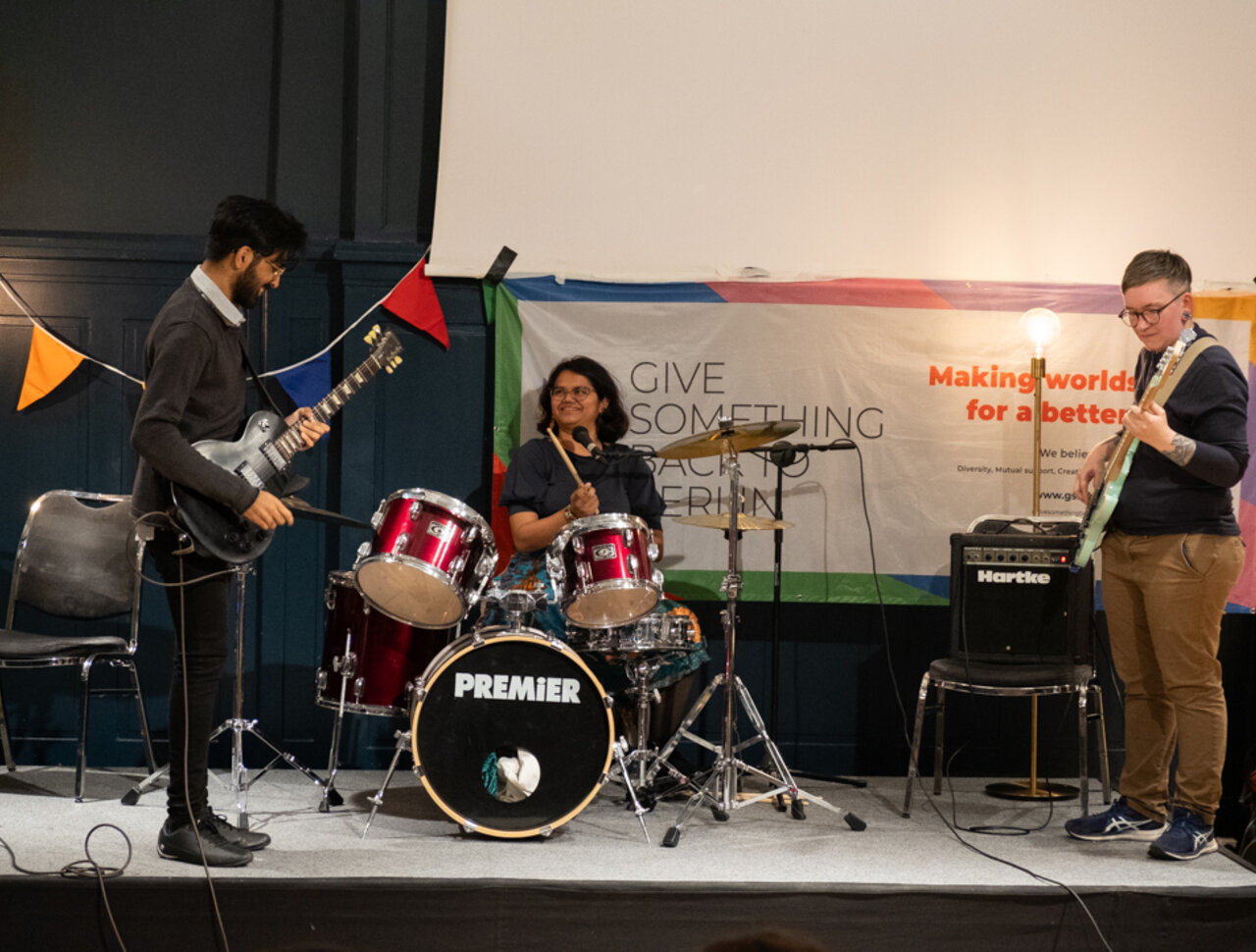
Hello, my name is Sonika Malloth. I’m originally from India and moved to Berlin 1.5 years ago. I work part-time as a software engineer and have been drumming for over a decade. I’ve also been learning Konnakkol, an Indian vocal percussion art form, for 5 years. I’ve started a part-time masters in Machine Learning this October and hope to dive into research in the field of Computational Musicology after my masters.
I’ve been with GSBTB for about 6 months now. I found them while looking for music production courses in Berlin and ended up volunteering as a drum teacher at Open Music School. I’ve also held a couple of Konnakkol workshops which were very successful and I look forward to doing more!
For those unfamiliar with Konnakkol, how would you describe what it is?
Konnakkol is a South Indian vocal percussion art form where rhythmic syllables are vocalized in complex patterns. It is an ancient art form that dates back over 5000 years, rooted in the traditions of South Indian Carnatic music. It has been passed down through generations as both a performance and teaching method for rhythmic patterns. Musicians use their voice to replicate the sounds and patterns typically played on the percussion instrument Mridangam. This art form requires a deep understanding of rhythm and improvisation, making it both a musical and mathematical skill.
What are the key techniques or elements that make up Konnakkol?
Konnakkol is built around key elements like solkattu (rhythmic phrases) and tala (rhythmic cycles – similar to time signature in western music) that define the structure and timing of a piece. It has a 35 tala system, which allows for very complex compositions in unique time signatures. Musicians use precise syllables to vocalize complex patterns, incorporating nadais (subdivisions) and kaarves (rests) to add rhythmic variations. Speed, clarity, and improvisation are crucial, allowing artists to create dynamic and intricate rhythmic phrases.
In Western music, rhythm is often conveyed through instruments like drums or notation. How does Konnakol, as a vocal form of rhythmical expression, compare to the way rhythm is expressed in Western musical traditions?
Konnakkol differs from Western musical traditions by using the human voice instead of instruments or written notation to express rhythm. This vocal approach enables a direct and flexible way to teach, learn, and experiment with rhythm, emphasizing precision, speed, and improvisation. As a result, Konnakkol is not just a performance art, but also a unique method for internalizing and mastering complex rhythmic concepts. The combination of syllables in the solkattu patterns allow for rapid vocalization, making it easier to reach higher tempos.
How has Konnakol evolved over the years, and how is it being adapted in contemporary music scenes globally?
Traditionally used to enhance rhythm in classical performances, the intricate patterns of Konnakkol have gained attention from global musicians looking to incorporate diverse rhythmic structures into their work. In contemporary music scenes, Konnakol is being adapted into genres like jazz, fusion, and even electronic music, where artists blend traditional syllables with modern instrumentation. This fusion often serves to highlight the versatility of rhythmic concepts from Indian music, making them accessible to a wider audience. Workshops and collaborations between traditional musicians and modern artists have further facilitated this evolution. Additionally, Konnakol’s incorporation into global music festivals and workshops showcases its growing acceptance and appeal beyond its cultural origins. As a result, Konnakol continues to bridge cultural divides, fostering creativity and innovation in the global music landscape.
How did you first become interested in Konnakol, and what inspired you to pursue it as a performing art?
For six years, I immersed myself in the world of rock and metal music as a drummer. My journey included jamming with various bands, releasing an album, and performing professionally under a talent agency. I also achieved the highest grade in the Trinity Music School Certification exams. Along the way, I honed my skills in sight reading and explored diverse musical genres, mastering common time signatures like 4/4, 3/4, and 7/8. However, I often felt confined, particularly in improvisation, stuck in the familiar patterns of 16th notes subdivision within a 4/4 groove. At that time, a family friend who is a talented Carnatic flute artist, introduced me to Konnakkol. This captivating rhythmic vocal art form opened up a new realm of possibilities, inspiring me to expand my rhythmic vocabulary and break free from my creative rut.
What does Konnakol mean to you personally? How has it shaped your identity as a performer?
I can’t imagine my music without Konnakkol. This rhythmic vocalization has provided me with a deeper understanding of music that I never quite achieved as a drummer. Konnakkol beautifully combines music and math, appealing to both my nerdy and creative sides. I love composing complex rhythms, and mastering Konnakkol has made it much easier for me to create patterns on the drum kit. Being able to vocalize the rhythms helps me grasp the timing on the kit more intuitively. I’ve even found that the same principles apply when I transfer Konnakkol rhythms to other instruments like the ukulele, tongue drum, kalimba, and guitar. It’s been a rewarding journey that continues to expand my musical horizons.
What musical projects are you currently working on? What’s next for you as a performer? Any exciting projects or collaborations?
I’ve really embraced every kind of collaboration with Konnakkol, eager to contribute to its global reach as a unique rhythmic language and a way to infuse rhythm into other art forms. I play drums, ukulele, and a few percussion instruments, and I love transferring Konnakkol rhythms onto these instruments to showcase its diversity. This year, I teamed up with a hip hop dancer to explore how we could use Konnakkol rhythms as a base for dance choreography. Recently, I performed with a blues and funk band, playing drums while vocalizing Konnakkol, and then with a metal band that added Indian fusion elements. It was intriguing to see how my vocalizations shifted depending on the genre and the artists I was working with. Next month, I’m looking forward to a new project with a DJ, which we’re calling Konnakkol beatboxing. We’re still figuring it out, but I’m really excited to see where it takes us!
Anything else you’d like to share?
From my personal experience, Konnakkol is a valuable skill for artists across all genres, helping them to expand their rhythmic horizons. I encourage everyone to view Konnakkol not as a separate world but as a way to enrich and add depth to their existing craft. Whether you’re a drummer, guitarist, keyboardist, or singer, Konnakkol can be learned as a standalone art form or as an extra skill to enhance your performances. Embracing Konnakkol opens up new possibilities and adds a vibrant layer to your artistry.