
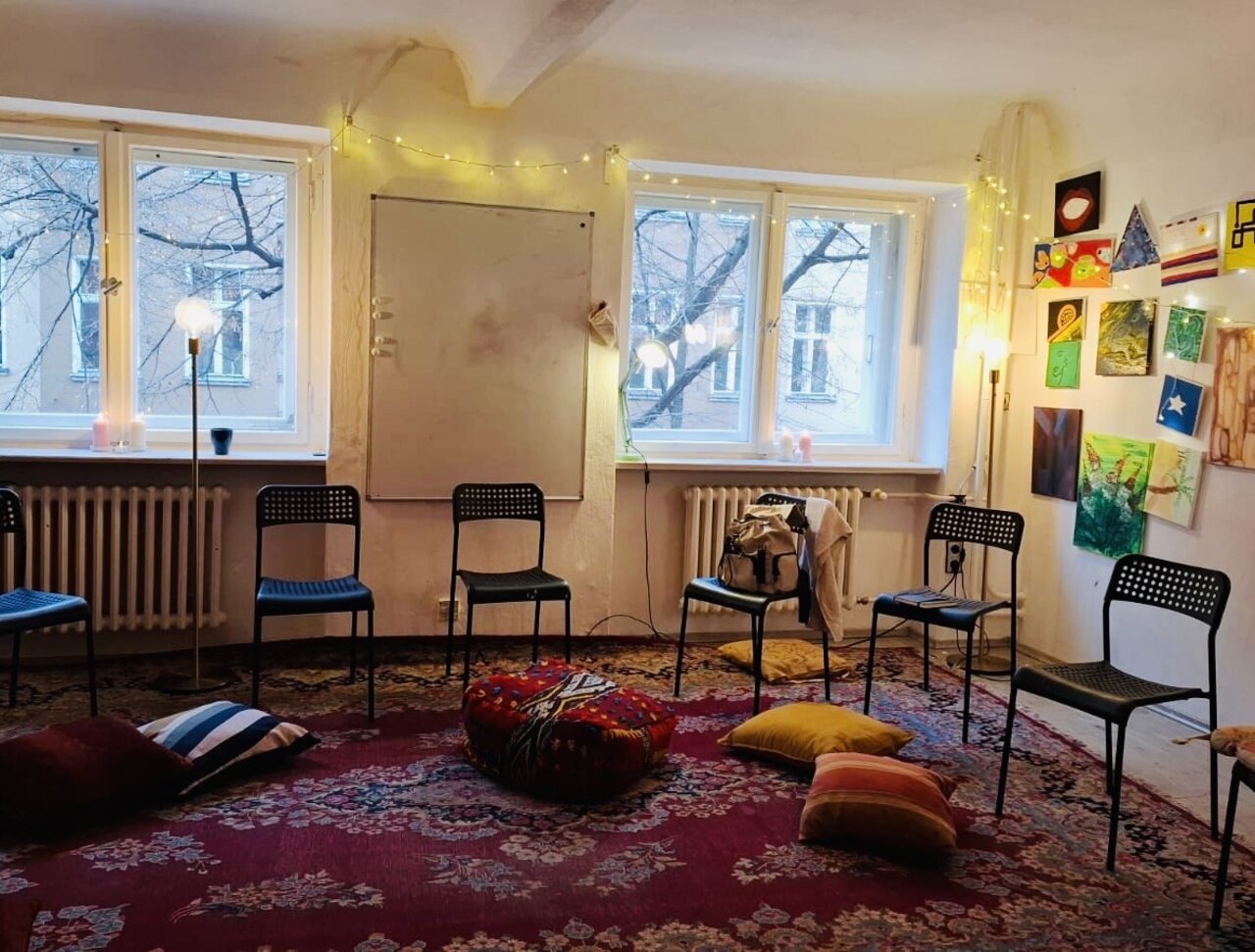
There are many ways mindfulness is talked about these days and very often as a tool to manage stress, stay focused, or become more productive. But what if it could also be something else? At Hejmo, our Mindfulness Circle for women didn’t begin as a solution to a problem, but as a response to a need we kept encountering in different forms: the need for a space where you don’t have to arrive feeling calm, and where there is no expectation to leave feeling “better”.
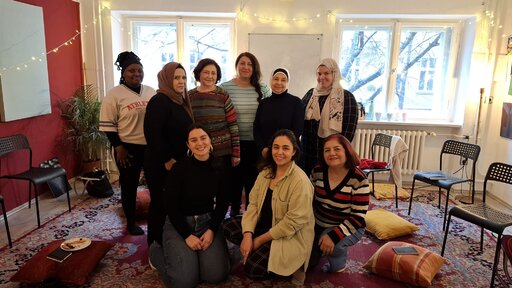
For the past months, these sessions have become part of our Open Hearts Space, a women-centered program where care is approached slowly and collectively. Once a month, for two hours, a group gathers - sometimes quietly, sometimes in conversation, sometimes simply sharing the same room. There is no pressure to participate in a certain way, no expectation to share, and no idea of doing things “right.” What matters is that the space exists, and that people can enter it on their own terms.
The sessions are facilitated by Majd, whose work is shaped by both her personal journey and her professional experience. She grew up in Amman, Jordan, in a family of Palestinian refugees, and her understanding of wellbeing is deeply connected to questions of belonging, displacement, and care. “I know a thing or two about the concept of diversity and the importance of inclusion because I have lived much of it,” she shares. Her path into mindfulness was not linear: moving through different ways of making sense of care, from religion to self-help to therapy, before finding contemplative practices that felt more grounded in her own experience.
Over time, her work has also taken her into more formal settings, facilitating mindfulness workshops with international organizations. But rather than reinforcing a standardized approach, this only deepened her interest in designing practices that are personal, culturally relevant, and adaptable. “Doing the things we already do, but with intention and kind attention,” is how she currently describes mindfulness - a definition that leaves space for interpretation, rather than prescribing a single way of practicing.
This openness is central to how the sessions are held. Rather than offering a single way of practicing, Majd invites participants to find what feels meaningful to them; whether that involves stillness, movement, or something else entirely. The practices are not meant to be followed exactly, but adapted, questioned, and sometimes even set aside.
At the same time, her work is grounded in a critical awareness of how mindfulness is often used. In many contexts, it is introduced as a way to help people cope within systems that remain unchanged — placing the responsibility for wellbeing on the individual, rather than addressing the conditions that create stress in the first place. Majd’s approach moves in a different direction. Rather than asking people to adapt more efficiently, it invites a slower, more attentive relationship to themselves and the world around them.
This also means letting go of the idea that mindfulness should make us feel better all the time. In practice, it often does the opposite: creating space for emotions to surface, including discomfort, grief, or uncertainty. Instead of pushing these feelings away, the work becomes about staying with them, noticing them, and allowing them to exist without immediately trying to change them. In this sense, mindfulness is not about reaching a certain state, but about shifting how we relate to whatever is already present.
In a community space like Hejmo, this takes on an additional layer. The sessions are not offered as a service, but held as a shared space that people shape together. Trust plays an important role here: the familiarity of the environment, the relationships that already exist, and the sense that participation is always a choice. As Majd reflects, “a safe space, a supportive environment, and the freedom of choice are essential elements of these practices,” all of which are rooted in how the space is held collectively.
We do nothing for the community without the community, and this is no exception. The Mindfulness Circle continues to evolve with the people who join it, shaped by their needs, their presence, and the ways they choose to engage.
Maybe mindfulness, in this context, is not about becoming a different version of yourself, but about meeting yourself in all the ways that might feel unfamiliar, uncomfortable, or unfinished.
And maybe what makes that possible is not the practice itself, but the fact that you don’t have to do it alone.
With thanks to lululemon Gives for supporting the continuation of these sessions and helping us keep this space open. lululemon Gives is a global impact initiative and the next evolution of the lululemon Centre for Social Impact. This initiative is backed by a $100 million USD commitment to advance mental health and wellbeing by harnessing the power of movement and mindfulness and aims to impact 20 million people worldwide by 2030.