

What first drew you to this work, and why has it remained important to you?
My work has always been tied to building future, hope, and energy. Building the human, but also dreaming of what could come next. My own youth was shaped by escaping war and living between countries, so it was never a casual kind of youth. What kept me going, and what continues to inspire me, is seeing young people who, despite everything, are full of hope and energy. For me, youth represents potential and possibility. If you give them the right environment, they flourish in incredible ways.
Looking back at your own journey, what skills have been most valuable to you, not only professionally but as someone who has lived through migration?
On a human level, the interpersonal skills. Navigating a new life, a new culture, a new language. Resilience isn't something you choose, it's something migrants and refugees are often forced to build, some more successfully than others. I learned to read a new space and time and figure out what actually makes sense for me within it. I also learned when to slow down and when to move fast, not in a grinding way, but in a way that's focused on real growth.
You cofounded the Syrian Youth Assembly. What inspired you to create it, and what impact are you most proud of today?
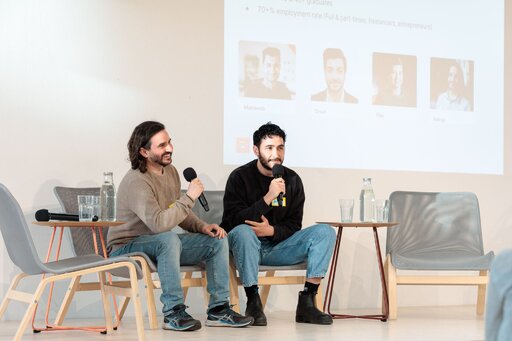
I was eighteen when the war started, right after finishing high school, and I spent the following years living between countries. We lost access to education, at times to basic things, and were constantly on the run. That experience is what pushed me to want to build a better future and new opportunities for myself and others like me. The idea for the Syrian Youth Assembly came together in 2016 in Istanbul, at a humanitarian summit, when a group of young Syrians decided to do something for their community. We asked what we could offer and what was needed most, and built from there through educational partnerships and youth, peace, and security work.
What I'm most proud of today is the community we built, over 250,000 members, and more than six million hours of study completed through our partnerships. We gave people access to German, English, job opportunities, mentorship, and internships. Watching that community grow and giving people a second chance is what I'm proudest of.
What have young people taught you over the years that you didn't expect to learn?
Honestly, I'm not sure I'd call it unexpected, but what always strikes me is how adaptable and resilient young people are. That endless energy for life is remarkable, you almost cannot defeat them. They're stubborn in the best sense, they just keep going. Through our programs we've met people, inside and outside Syria, who've done incredible things against real odds, learning a language from scratch, working freelance, moving countries, all while holding onto their dreams. What I've learned is that as long as someone keeps trying, they find a way toward a better tomorrow. And the beautiful part is that it stays with you. Once you've lived through hardship and still managed to grow and change your dreams, that becomes part of your identity. You carry that belief in yourself forward.
You've lived and worked in different countries. How have these experiences shaped your understanding of community, belonging, and social change?
Community, to me, is like a chosen family. You can join one or build your own, and in every country I've lived in, especially outside Syria, I've found some kind of community or social setting that fit who I was at that point in life. That's powerful when you think about it, you can arrive somewhere knowing no one, with a different language and culture, and still find a place to belong.
Belonging is probably the most important thing to have in a new place, right after the essentials like income, housing, healthcare, and language. Those things matter, but they're not the core of belonging. The core is having a place where you can be yourself, where the social and cultural pressure eases enough that you can grow. That's when your roots really start to go deeper, when you begin seeing your reality differently.
Social change is more demanding to talk about. For me, there's always been a kind of fire that never turns off around it. Social change can be measured in numbers and impact, and that matters, but there's also a part of it that happens in people's hearts, the part you can't fully measure. What I've learned is that the most powerful part of social change is being there, face to face with the community, working alongside people, and watching them grow. That's the part that's stayed with me the most.
Are there approaches or ideas you've encountered elsewhere that you think Germany's social sector could benefit from?
Yes, a few things come to mind. The first is community led, peer to peer work with real ownership for migrant communities. In Germany it's almost always top down, migrants are done to, projects are designed for migrants rather than with them. Funds often go to organizations that work on behalf of migrants instead of alongside them. I think ownership needs to shift, because the people who live the issues are the ones who understand them best, and their ownership is essential if we actually want to solve them.
The second is mentorship. Real, sustained mentorship, not just a workshop or a one time session, but relationships that follow people through their journey and open doors along the way.
And the third is thinking beyond grants and reporting cycles toward real social business ideas. Building entities that can sustain themselves financially, that aren't dependent forever on the next funding round, and that can grow at their own pace according to their own needs rather than a funder's timeline. That kind of structure creates space for communities to build something lasting, not just project by project.
Throughout your journey, what has helped you feel at home in a new place?
It's a mix of things. Small sensory moments matter a lot, hearing a language you've just started learning out on the street and understanding what is being said, a familiar dish, something that quietly tells you you belong here. Building and choosing your own community matters just as much, finding people or creating a circle that fits who you are at that point in your life.
Language plays a big role too, but even more than that, it's the feeling that a place is trying to make itself growth oriented rather than just focused on survival and basic needs. A place that asks how we, host country and new arrival together, can build a future rather than just manage the present.
And maybe most important, having a safe space to learn and just be, without the pressure to constantly perform or change yourself to fit in. That's really what makes somewhere start to feel like home.
Many people come to Hejmo looking for connection, community, or a sense of belonging. What does belonging mean to you personally?
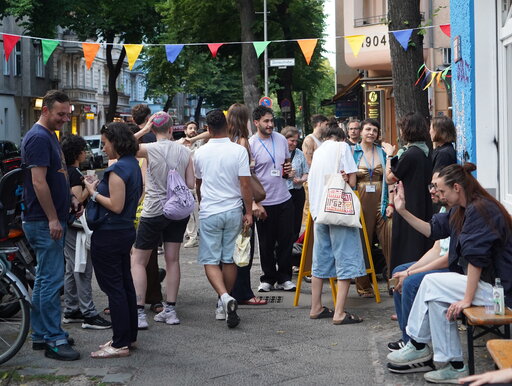
Belonging, for me, is having a place where you can be yourself, without the pressure of constantly proving or changing who you are. It's what comes after the basics, income, housing, healthcare, language, it's the deeper layer where your roots actually start growing into a place. It shows up in small things, a language you're learning starting to feel personal rather than functional, a familiar dish, a smile exchanged with a stranger on the tram. It's a mix of finding community and choosing it, of feeling safe enough to grow rather than just survive. And ultimately belonging is what lets you start seeing a place not as somewhere you're passing through, but somewhere you're building your future.
As Hejmo's new Program Director, what experiences and perspectives are you most excited to bring into this role?
I'm excited to bring my own experience of belonging as someone who has lived across different countries, alongside my expertise in empowering people to build the foundations they need in a new home, whether that's skills, opportunities, or connections. I also bring experience in social business and a network that I hope can help Hejmo grow in certain areas. At the same time, I'm genuinely excited to learn from the many years of belonging work Hejmo has already built. It feels like a real opportunity for me to grow, to learn, and to give something back to Berlin.