By Vedika Singhania
In my first week in Berlin last summer, I was returning home from a workshop. It was already quite late even for a summer evening, so I was debating whether to walk back or take a train. Amidst this indecision, I walked into Treptower Park S-Bahn, and got pulled into a group of people dancing to loud music blasting from a makeshift speaker. I turned to some fellow passengers and enquired what was going on. They replied, as if it were the most obvious thing in the world, “It is just a rave”. Perhaps they saw the confusion on my face and drew a conclusion from my widened eyes, so they
added, “Welcome to Berlin!”.
I lost my earphones that winter, and decided to see how long I could last without getting my sibling to buy me a new pair. Without fail, music continued to accompany me everywhere anyway: protest music and drums echoing through pro-Palestinian solidarity demos on Hermannplatz; the good old Kajra re and Bole Chudiyan on the TV at a döner shop in Prenzlauer Berg; karaoke sing-off of Nazia Hassan’s Disco Deewane at a South Asian community gathering (when I learnt that it is not originally a Bollywood song!); DJ set-up on the bridge outside my library at Hallesches Tor for one straight week, come rain or sunshine; Lonely Boy by street performers near Warschauer Str where I frequently change trains; and every now and then after our group dinner, a dear friend’s gentle reminder to listen to Yunchi Ensemble, a band from Kyrgyzstan who have two monthly listeners globally.
While I knew, at least in theory, that club techno was central to Berlin’s musical identity, all my experiences of living and moving around in the city suggested otherwise. I was convinced that there was far more than what meets the eye (or my ears). At GSBTB’s community gathering last week, we organised a panel of music experts and practitioners in the city to address some of our questions about this glaring gap.
George Athanasopoulos, who teaches courses on the intersection of migration, music, and globalisation, shared that Berlin’s music scene didn’t emerge overnight with the fall of the Wall and the rise of techno four decades ago. Migration, beyond the recent decades, has been shaping Berlin’s soundscape for centuries. In fact, musical innovations brought by migrant communities from various time periods and geographies, in various shapes and forms, have existed in the undercurrents of the city for over four hundred years now! These collabs didn’t necessarily happen in clubs, but rather through everyday life, by acts of being and living together. They gave rise to a multitude of sounds that have now seamlessly blended into the city’s soundscape. “Music, much like our social identity, is never static,” George adds, “it is constantly changing every moment of our lives. When people arrive in Berlin, they bring these memories. And when musicians from different cultures collaborate, it naturally shifts how we see ourselves, and perceive each other.”
At Fête de la Musique last year, I heard a young musician Ceren perform her song, Dünya. The lyrics were a mix of German and Turkish. That performance stayed with me for months. It was perhaps for the first time I had felt that there was a possibility that the walls between my different
art worlds could also dissolve and melt away.
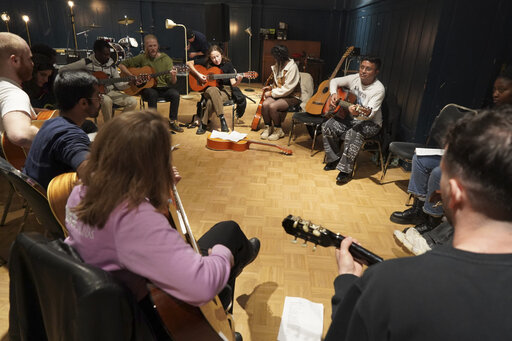
As migrants, we’re constantly code-switching, so multilingualism in any sphere of life, art or otherwise, is not a foreign concept to us. But instrumental music felt like a different ball game. So I asked Sonika Malloth, my drum teacher at Open Music School who also practices Konnakol, a South Indian vocal percussion form, how she navigates it. Sonika says, “Sure, not everyone will understand when I say ‘Trisra gathi in Chaturasra Jaathi Eka Taala,’ but if I tell them, ‘Let’s try eighth-note triplets in a 4/4 time signature,’ suddenly it clicks.”
I have no technical background in music, so it still didn’t click for me. Then she added that traditionally in Konnakol she uses phrases like Tha Tha Tha Tha, ThaKa ThaKa ThaKa ThaKa, ThaKiTa ThaKiTa ThaKiTa ThaKiTa and so on, to practice. But when recently when she was practicing with a young student, she used phrases like “Man Man Man Man,” “Batman Batman Batman Batman,” and “Naruto Naruto Naruto Naruto.” She believes that much like how one plus one in all parts of the world is always two, likewise, rhythm is universal. They are not limited by social constructs of borders and traditions. But only by the imagination and willingness of its practitioners.
This sentiment was also echoed by Kimia Bani, whose music, including her instrument, daf, informs an integral part of her cultural identity and political expression. Kimia employs music as a vehicle for resistance and empowerment for marginalised groups, particularly women, queer individuals, and for voices that are frequently excluded from dominant narratives. When she organises community musical events, she resists jumping straight into performance. “People are more important than music”, she says, “so at our gatherings, we talk about our lives, we talk about our stories, and ultimately these feelings feed into the music we create together”.For Kimia, music is first and foremost a tool for expression. When she collaborates with people from various backgrounds, be it DJs, electronic musicians or western instrumentalists, she
explains, “we have to get close to each other, and care about each other’s lives and work, and that is a beautiful experience”.
Some time after my “Welcome to Berlin” moment, I was holed up in my room working on my thesis. I heard a soft knock on my door. It was my flatmate, with whom I was trying to break ice for four weeks, but we had exchanged barely four words over that period of time. She said, “I overheard some music from your room earlier, will you share your playlist with me?”.
So I did.
Now, at the risk of sounding overly dramatic, I must admit, I have still not bought another pair of earphones. I am increasingly growing fond of the playlist that this city of Berlin curates for me.
The expert insights are drawn from a panel discussion titled “How does migration shape Berlin’s ever-evolving sound?”, moderated by Vedika Singhania, and facilitated by GSBTB as part of a community gathering ‘Sounds of Berlin’ on June 19, 2025.
Support Open Music School and Open Music Lab in making music accessible to everyone — buy their tracks on Bandcamp!