
Community Cake does Christmas
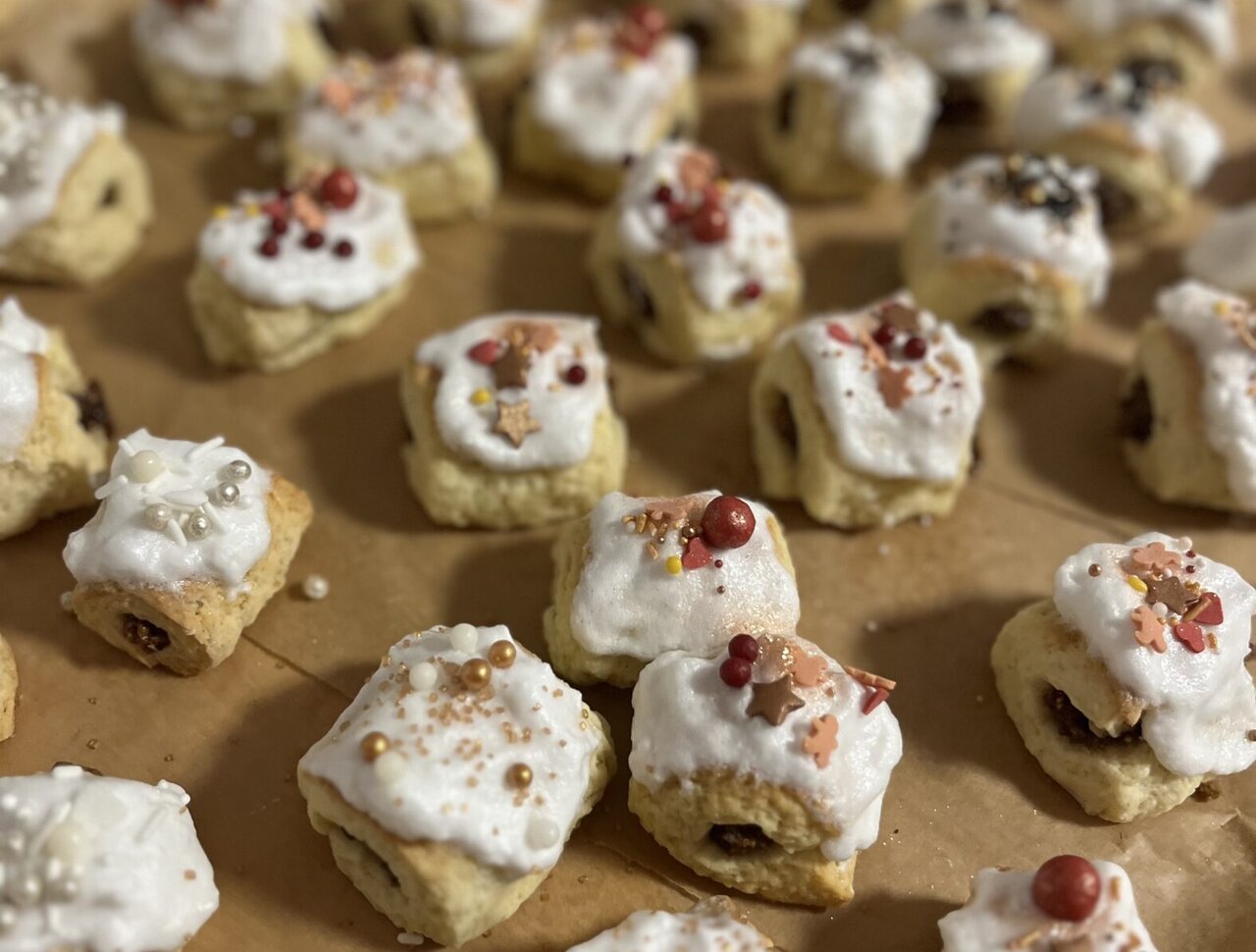
The year is coming to an end, the days are short and the streets are cold. But the kitchen is warm, bright and smells incredible. The fragrance of vanilla, ginger, cinnamon, cardamom and nutmeg hangs in the air. Christmas songs are blasting and we’re warming our hands and hearts by baking Christmas cookies that have been passed down through the generations, or not.
Angela, Lauren and I meet up on a cold December day to share stories of baking, family and tradition. Sofia joins us spontaneously to help and we bake. Read more about our individual experiences below.
Angela
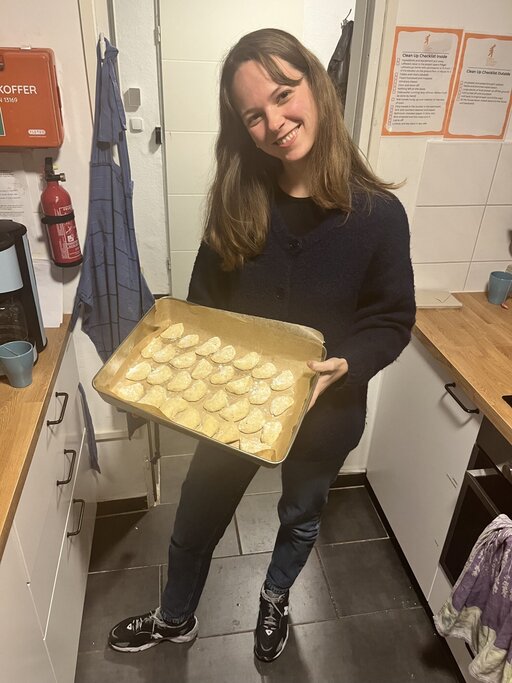
Growing up in a German-Catalan household in Barcelona, my mother’s way of connecting us to her German roots was through cooking. While I’ll always have a soft spot for Spanish cuisine (how could I not?) when it comes to baking, the Germans give it a run for its money.
Some of my favorite childhood memories are of the weeks leading up to Christmas. My mother and I would spend hours in the kitchen, surrounded by the scents of melted butter, vanilla, and spices, baking cookies together. She’d rummage through her recipe books until she found her handwritten notes with my great-grandmother’s Christmas recipes, all worn out by the years of use .
We’d start with her famous Mürbeteig, rolling it out and cutting cookies into all sorts of shapes. I’d sneak bites of the leftover dough from every batch, knowing full well I’d regret it later (still worth every stomach ache). In those moments, it wasn’t just about baking—it was a way of stepping into my mother’s world, into the traditions she grew up with, creating a tiny bubble of connection that felt like it was just ours.
I’ve always felt caught somewhere between cultures—never fully Spanish, never fully German—but in those moments, I got to share a piece of her upbringing and create something that felt uniquely ours. Far from Germany, in our Barcelona kitchen, we made traditions that were genuine and true to us.
Last year was the first Christmas I didn’t spend in Barcelona and missed our baking gathering. Still, I wanted to keep the tradition alive, so I attempted to make Vanillekipferl. I failed miserably , but it became an excuse to call my mom every five minutes for advice. Even across the distance, we found a way to share the moment.
This Christmas I’m heading back home to Barcelona with a suitcase stuffed with Lebkuchen and Bourbon vanilla sugar, ready to dive into our family traditions once more. But before that, I get to start the season early, baking Vanillekipferl with Ricarda and Lauren in our cozy project space—a new twist on an old tradition that feels just as special.
So here it goes, my great-grandmother’s Vanillekipferl recipe!
Ingredients and Preparation
Vanillekipferl are relatively simple in terms of the ingredients. Just make sure you never let the dough get too warm, as that would melt the butter and the cookies would lose their nice crumbly texture.
Vanillekipferl
Makes about 30 cookies
125g butter
125g sugar
250g flour
1 egg
1 egg yolk
2 packs (bourbon) vanilla sugar (divided)
100g ground almonds
2 knife tips baking powder
Icing sugar (for coating)
In a mixing bowl, cream the soft butter with the sugar, egg, egg yolk, and vanilla sugar until fluffy.
Mix the flour with the baking powder, then add it to the butter mixture along with the ground almonds. Knead everything into a smooth dough. Leave to rest in the fridge for a little while.
Shape the dough into evenly sized rolls, then cut into small, equal-sized pieces. Shape each piece into a crescent (half-moon).
Place the crescents on a baking tray lined with parchment paper. Bake in a preheated oven at 175°C (top/bottom heat) for about 10 minutes. They are ready when the tips start to turn slightly golden underneath.
While baking, mix the powdered sugar with the vanilla sugar in a bowl. Once the cookies are out of the oven, let them cool for about 2 minutes—this prevents them from breaking—then gently coat them in the sugar mixture.
Let the coated cookies cool completely on a wire rack. Store them in an airtight tin to keep them soft and delicate.
Lauren
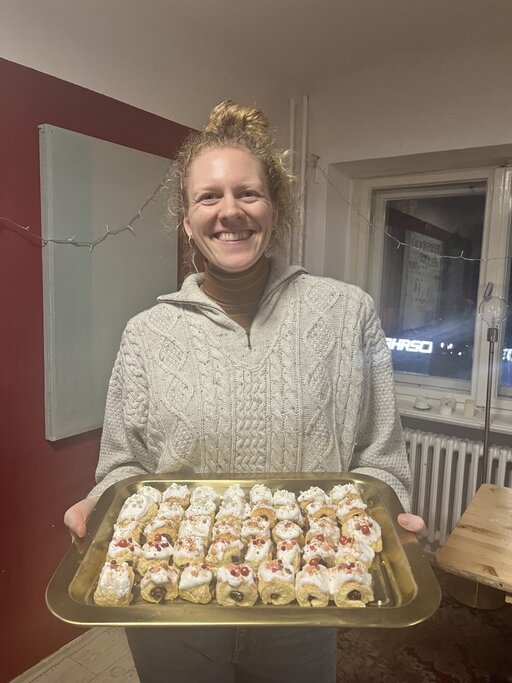
My grandmother’s side of the family is Italian, and every year all of her cousins get together to make huge batches of these cookies at Christmastime. The recipe my grandmother sent me when I asked for it was for a batch of 400 cookies! So you can only imagine the amount of work and love the women on that side of my family put into their Christmas baking. Growing up, I didn’t like the taste of the figs, so I never ate the cookies, but as I got older I began to appreciate them. Now anytime I go back to visit, I ask if there are any fig cookies left to try.
These Italian Fig Cookies or Cuccidati are originally from Sicily. It’s a traditional Sicilian Christmas dessert, made by Sicilian families which also made its way across the Atlantic to Italian American families. It combines ingredients from diverse cultures which reflects the multifaceted history and culture of this beautiful island. The cookies are really only made around Christmas and it’s very common for the women of the families to come together to make the cookies, since it is such a labor intensive process. There are variations of what people like to put in the filling and occasionally different shapes, but for the most part these cookies have remained the same.
When I asked my grandmother for the recipe she didn’t seem confident that we would be able to pull it off for our baking session. She probably imagined that I would also try and make 400 of these with the help of only 3 other people in a single afternoon. She did try to offer me a simpler recipe. Thanks for the vote of confidence, Nana 🙂
I made these for the first time for this feature and they came out beautifully. I did send her a picture of our finished cookies and she was very proud of us. “If anyone could pull it off, I knew it was you.”
Ingredients and Preparation
These cookies are jam-packed with all things Christmas: dried figs, pecans, raisins, candied pineapple, candied cherries, allspice, cinnamon.
Cuccidati/Italian Fig Cookies
Makes about 40 cookies
Filling Mixture
300g dried figs
50g pecans
50g candied pineapple
50g candied cherries
½ tsp allspice
1 tsp cinnamon
75g sugar
⅓ orange, rind and juice
Dough
500g flour, plus extra for rolling out
4 tsp baking powder
100g sugar
1 pinch salt
75g shortening/butter
2 eggs
120 ml whole milk
½ tsp vanilla extract
Icing
2 egg whites, beat until stiff
125g powdered sugar
2 tsp lemon juice
sprinkles
Mix all the filling ingredients well by hand, then run through the food processor or chop finely. Set aside in a bowl.
Preheat the oven to 180°C. For the dough, mix dry ingredients then work into wet ingredients. Set aside in a cool place for 10 minutes.
When you’re ready to roll them out, sprinkle the work top with some flour and roll the dough to about ⅓ cm thickness. Cut strips of dough approximately 7.5cm wide and 30cm long. Roll the filling into a 30 cm long tube shape and lay filling on a strip of dough lengthways. Roll the dough around the filling. Once rolled into a 30 cm long tube shape, cut into 5 cm long cookies. Make sure the dough is well sealed so it doesn’t fall apart when rising in the oven.
Bake for about 8-10 minutes or until golden brown. Allow to cool completely.
For the icing, beat the egg whites until stiff. Mix in the powdered sugar and lemon juice. Cover cookies in icing and colorful sprinkles.
Ricarda
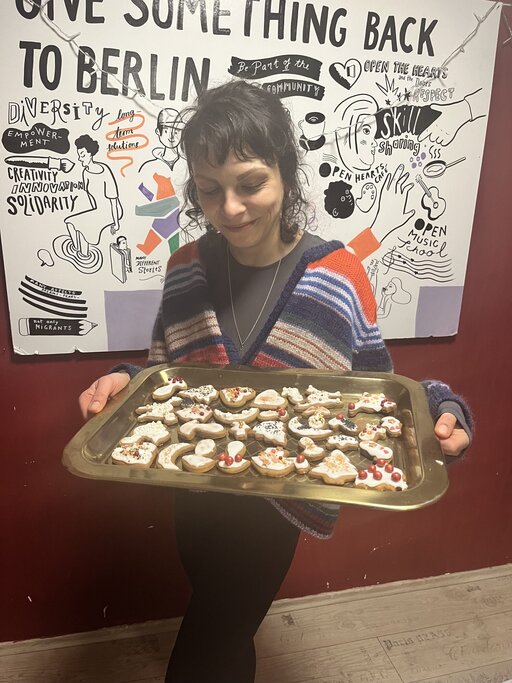
Unlike the other two, I have very few memories of baking Christmas cookies in my family growing up. So when the idea for this came up, I asked both my parents. Is there a family recipe on your side of the family that I missed somehow?
And the answer was: not really…
My grandmother on my father’s side would sometimes make simple Butterplätzchen. But she lived quite far away and we didn’t really see her for Christmas. And my grandmother on my mother’s side really liked Makronen with hazelnuts or almonds. My mother would begrudgingly make them to bring along on visits. I do have some vague memories of this but it wasn’t really a shared activity in our Adventszeit. I know I have been rather unkind about my mum’s baking in the last few features too. But she would be the first to tell you how little she enjoys it. So I don’t think she will mind reading this.
Since I seem to be the first avid sweet baker in the family for a few generations I had to find my own traditions. To this day, my Christmases are very much centred around British customs due to the many years I lived in Scotland and also because of my ‘adoptive’ family in Berlin. We celebrate together on the 25th of December rather than on the 24th, as would be customary in Germany. We make different food and listen to different songs than the ones I would have grown up with. In a sense I can relate to what Angela describes above about not being fully here nor there. And now that I have a child myself, we have started mixing and matching and also adding our own weird touches to it, just to spice things up even more. Christmas for us really is more of a time of doing ‘what we want’ rather than what is customary. And still, some of the classics are firm staples even in our weird and wonderful Christmases.
Enter the gingerbread. Obviously there is German Lebkuchen which would use similar spices, but this is a very different cookie. The british gingerbreads are flat biscuits, with more spices and more structural integrity. They are great for building gingerbread houses and as Christmas tree decorations.
Ingredients and Preparation
I like my gingerbread with loads of spices (surprise, surprise…) and dark muscovado sugar and treacle. The only issue with that is that it becomes harder to see when they are done because the uncooked dough is of a darker colour to begin with.
Some of the ingredients can be hard to find. Try the Biomarkt for the dark muscovado sugar and you can use Rübensirup instead of black treacle.
Resting the dough in the fridge overnight is crucial to let the flavours really merge and mingle. Plus, it’s great to have some in the fridge as easy child entertainment in the pre-Christmas time.
Gingerbread
Makes about 25 larger gingerbread people or 40 smaller shapes
Gingerbread
100g butter
105g black treacle or Rübensirup
105g dark muscovado sugar
50ml heavy cream
1 egg
2 tsp ground ginger
2 tsp ground cinnamon
1 tsp ground cardamom
¼ tsp ground allspice
¼ tsp ground nutmeg
¼ tsp ground cloves
¼ tsp ground star anise
350g flour, plus extra for rolling out
1 tsp bicarbonate of soda
½ tsp salt
Royal Icing
1 egg white
½ tsp lemon juice
300g icing sugar
Food colouring
For the Gingerbread Dough: Combine butter, treacle and sugar in a saucepan and place over medium heat. When the mixture is melted, stir in the ginger, cinnamon, cardamom, allspice, nutmeg, cloves and star anise. Remove from the heat and leave to cool for 5 minutes. Then stir in the cream and egg.
Combine the flour, baking powder and salt in a large bowl. Pour the wet ingredients over the wet ones and stir to form a soft dough. Wrap in cling film and leave to rest in the fridge for 24 hours roughly for the flavours to really blend.
Remove from the fridge about 20 minutes before you want to start shaping your cookies. Preheat the oven to 180°C.
On a lightly floured surface, roll out about ⅓ of the dough to 5-6mm thickness. Cut out the cookies using cookie cutters and transfer to a lined baking tray. Bake for about 5-8 minutes, depending on the size of your cookies. If you want to use them as decoration, make a small hole with a toothpick as soon as they come out of the oven. Leave to cool slightly, then move to a cooling rack to cool completely.
For the Royal Icing: Combine the egg white, lemon juice and icing sugar and using a hand mixer, beat until fluffy. Add a small drop of food colouring if desired.
Spoon some of the icing into a piping bag with a small, round piping tip and make sure not to overfill (or you can DIY a piping bag using a clear plastic bag and snipping off a tiny corner). Place the rest of the icing in the fridge. Ice the cookies as you wish. Go wild!