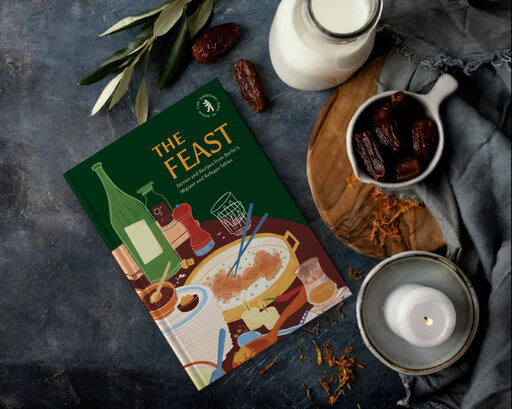
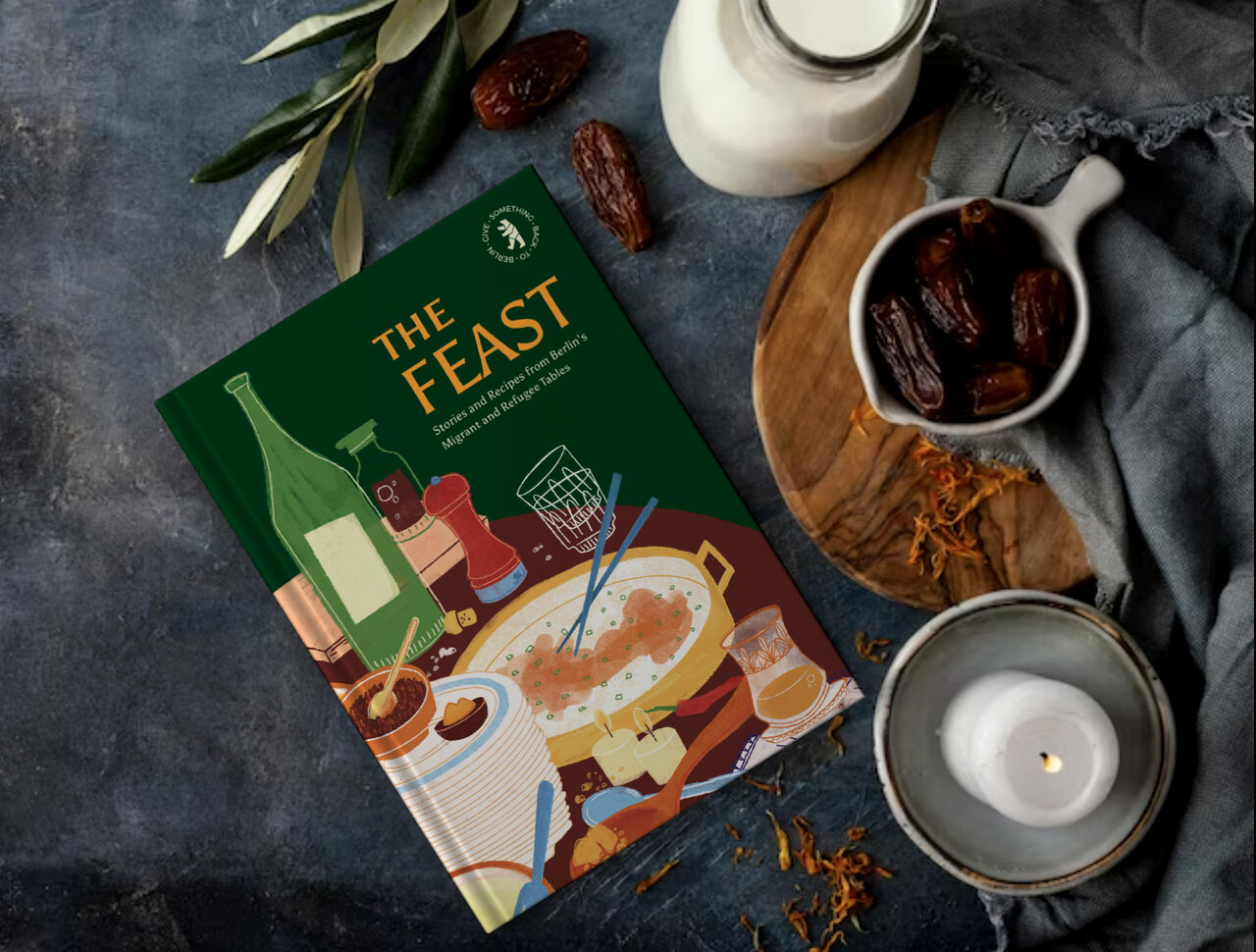
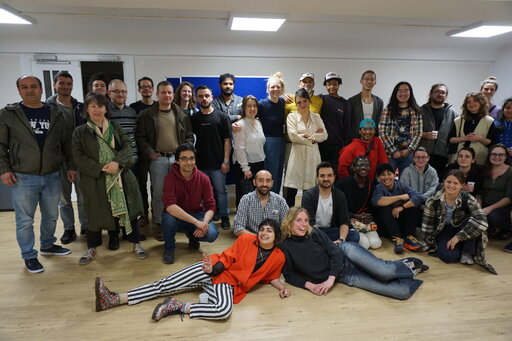
It was Eid al-Fitr, the Feast that marks the end of Ramadan and many familiar faces had shown up in the kitchen of Give Something Back to Berlin’s project space. Some arrived who hadn’t been there for months and everyone was greeted with a big smile. Today was going to be a big celebration.
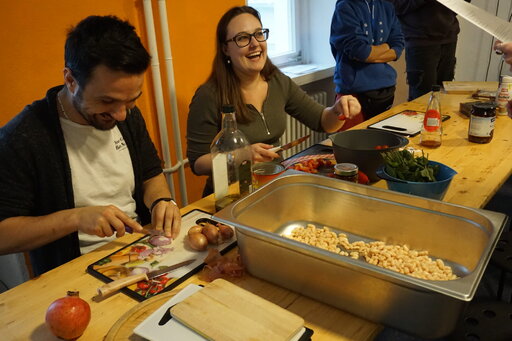
Shortly before six in the evening, several volunteers had gathered in front of the German Open Language Café, also held by GSBTB every Wednesday. Simultaneously, the Open Kitchen, a group centred around cooking with newcomers, refugees and locals, was also assembling. Lauren Stearns, a long-term volunteer, was busy checking a lengthy shopping list to ensure all ingredients for today’s four dishes had been gathered.
Today they planned to cook Mutabal, Muhammara, Hummus, and a Greek style salad. They expected 30 participants, but in the end, more than twice that number had attended. The doorbell hadn’t stopped buzzing and waves of people had swarmed into the small kitchen and an adjacent room to prepare the food together. Newcomers were greeted with warm smiles and friendly hellos as if they were already part of the community.
A place at the table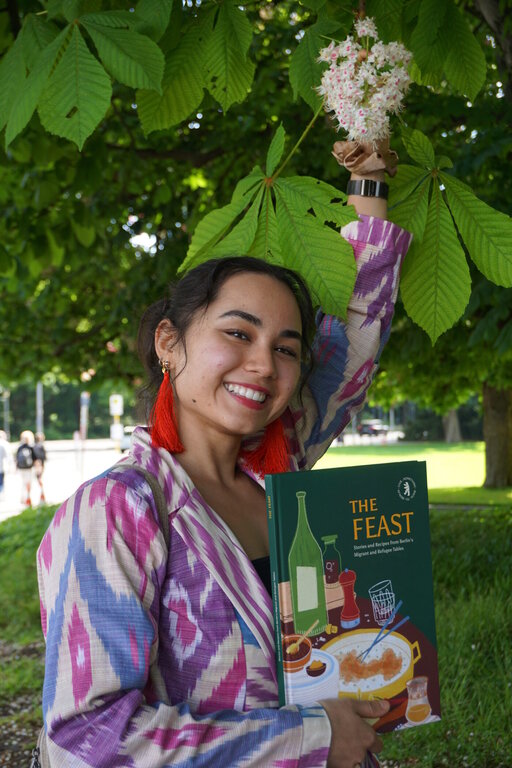
That’s exactly how Malika Yunus, one of the 15 protagonists of the cookbook The Feast, published by GSBTB in November 2023, remembers her first time with the Open Kitchen four years ago. “From the first day, it feels like you’re part of a family,” she recalled.
She had learned about the Open Kitchen through another member. At that time she had been living in Germany for over two years, but was still looking for her community. At Open Kitchen, she felt like she had finally found it.
“I love the environment they’ve created. I love the kind of people who attend. I love the fact that everyone is so welcoming”. Malika felt accepted and the Open Kitchen “was the first true community [she] had in Berlin.”
Many participants like Giuseppe Guerrero, share similar experiences. Giuseppe, another protagonist of The Feast, integrates his Neapolitan culinary traditions into his food projects while travelling, rarely staying in one city for more than six months in recent years.
Over the previous three summers, he stayed in Berlin to cook and teach people some of his recipes in the Open Kitchen. “We did one event together and after that, I just became a member of the community,” he said. That’s why he loves Berlin: its identity is shaped by all the diverse cultures that make this city their own.
The Core Team
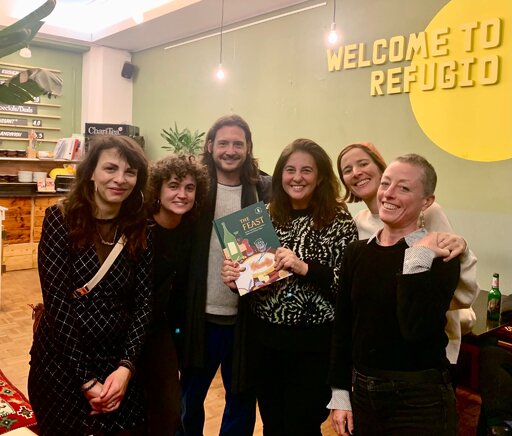
Almost six years ago, the project manager of the Open Kitchen, Ricarda Bochat, already had an idea of documenting the stories of its participants. “I always feel the work we do is so important in terms of dispelling narratives around migration and refugees. It empowers people by giving them a space to tell their stories and helps them realise that their stories matter just as much as anyone else’s.”
Jonathan Benjamin Small, the New York-born photographer of The Feast, happened to volunteer at the Open Kitchen at that time. He and Ricarda even conducted several interviews with other protagonists but the idea didn’t take off at the time.
It was only last year, 4 years after their initial idea was hatched, when former managing editor Böbe Barsi of The Feast joined the team, that their idea finally came to life. “She was the missing piece,” Jonathan told me.
Beyond All Differences 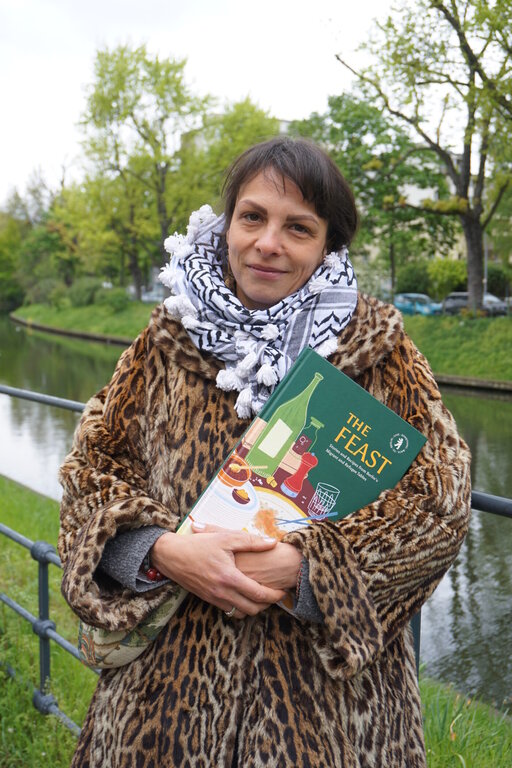
The trio formed a core editorial team and began researching the book market. They discovered that since 2015, amidst what was dubbed the refugee crisis, there had been many books in Berlin focused on refugees and food. “We didn’t want to produce just another refugee cookbook,” said Böbe. Instead, “The Feast” shifts the spotlight onto the Open Kitchen participants, aiming to showcase shared humanity through their diverse cultures and the stories behind their recipes.
Featuring 15 members of the Open Kitchen community from various countries such as Tibet, Uzbekistan, Syria, Sudan, Ukraine, Italy, Sweden, and the US, “The Feast” presents each contributor’s festive dish from their homeland. For instance, Tibetan momos symbolise the Tibetan New Year, while Mexican tamales signify the Day of the Dead, among other dishes.
With celebration as its core concept, “The Feast” offers a fresh narrative of migration. Celebration becomes the unifying theme that bridges differences, transcending boundaries as emphasised by both Böbe and Ricarda. This spirit, extending beyond the confines of the Open Kitchen and Berlin itself, illustrates, as Böbe pointed out, that “our similarities are stronger than our differences.”
People Like You And Me
With numerous participants in the Open Kitchen, the task of selecting representative protagonists seemed daunting. Ricarda stressed the importance of avoiding the trap of only showcasing stories of “model migrants.”
In “The Feast,” some protagonists are well-known figures like Malakeh Jazmati, a former Syrian TV chef turned restaurant owner in Berlin, while others are everyday individuals. “They’re just like you and me,” Ricarda emphasised, “but their stories are equally valuable, each contributing to the fabric of Berlin.”
The book features people from diverse continents, genders, religions, and ethnicities, offering a rich tapestry of migration stories. It aims to depict the varied experiences of migration in Berlin and beyond.
Not Manipulated Nor Edited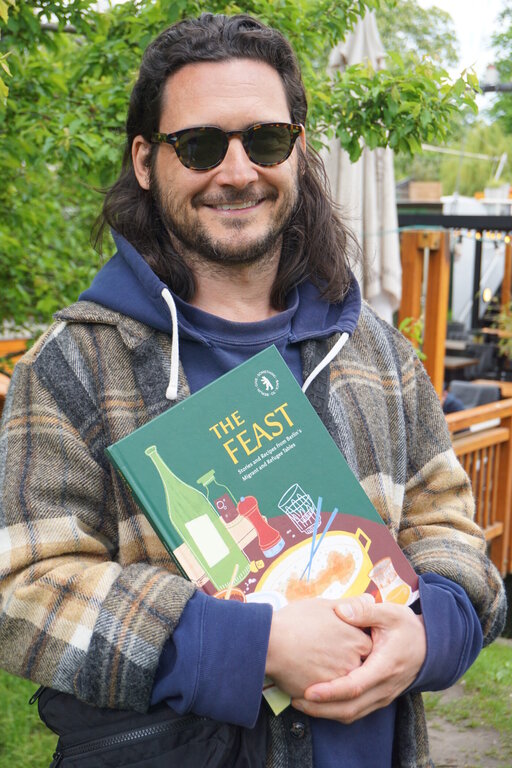
Once the core concept and protagonists were finalised, progress sped up. In March 2023, Worcester Polytechnic Institute in the US reached out to GSBTB, offering assistance. Four of their undergraduate students dedicated over four weeks to conducting interviews and gathering information for each dish and celebration, presented in the book as sidebars in each individual’s story.
Subsequently, in April, four writers were recruited. From May to August, it was a whirlwind period of writing, editing, and collaboration for both the photographer and the graphics team.
Jonathan, the photographer, drew inspiration from transcripts provided by the interviewers to create visual imagery that captured the essence of the protagonists and their stories. Through his photos, he aimed to convey the atmosphere of Open Kitchen events to those unfamiliar with the program.
Interestingly, all the photos in the book were captured on film. Jonathan began using film two years prior, in 2022, while documenting Ukrainians leaving their country. For him, film photography holds a special allure. “I like film a lot. It’s not manipulated. It’s not edited.”
The results were remarkable. Many protagonists expressed deep emotion upon seeing their photos at the book launch party.
Bringing dishes to life
Another significant contributor adding warmth to the book is Carolina Curbelo, the art director who collaborated with illustrator Veronica Alvarado and designer Lucia Boiani. Based in Uruguay, all three aimed to evoke a “home-like” atmosphere with illustrations that are both rough but warm in nature.
“We decided not to compete with the portrait photos of the people,” Carolina explained. Instead, they integrated details from the photos into the illustrations to establish a connection. For instance, everyday objects from the interviewees’ lives, like plants or candles in their rooms, are depicted in the illustrations.
Like many involved in the book, they also have their own migration experiences. Veronica, for instance, hails from Venezuela and now resides in Montevideo. Carolina expressed that these experiences gave them the confidence to create the book, as they understand what it’s like to be among people from diverse backgrounds in a new city.
Carolina also attended the book launch, where many protagonists expressed sentiments such as, “I never thought my life was important enough to be shared or included in a book.” To them, this book serves as a small gift from Berlin, a token of welcome and gratitude for their presence.
Always There on the Table
Malika, a native of Australia, understands the significance of creating a sense of home, even in unfamiliar places. Her parents, both of Uzbek descent, come from diverse backgrounds. Her father migrated from the Uyghur Autonomous Region of Xinjiang in China to Australia when he was 14, while her mother grew up in Sovietized Uzbekistan. Malika’s childhood memories are filled with trips to Uzbekistan and family gatherings where her grandmother cooked traditional dishes.
When Malika informed her mother about being featured in a cookbook, she strongly recommended including Plov, the most renowned rice dish in Uzbekistan, present at every celebration, including Eid in Uzbekistan. “It’s always on the table,” her mother emphasised.
In the book, Malika reminisced about her childhood antics to avoid plov, such as pretending to sneeze while discreetly disposing of the rice in tissues. However, while in Berlin, she has embraced her cultural heritage and now prepares her version of plov to share with friends, including on Eid this year.
She even took on the role of head chef during an Open Kitchen Wednesday, collaborating with other participants to cook Uzbek dishes. “It was amusing to see how recipes I grew up with were interpreted in completely different ways,” she chuckled, recalling how some participants struggled with instructions to thinly slice cucumbers, resulting in circles, slices, or cubes instead.
She takes immense pride in presenting dishes from her hometown. Growing up as an Uzbek kid in Australia, she once felt embarrassed to stand out. Now, she embraces her cultural identity, recognizing it as something that sets her apart and makes her unique.
Like many participants of the Open Kitchen, Malika understands the significance of being welcomed into a new country and finding safe spaces like GSBTB. “It’s comforting to belong to a community where others share similar experiences,” she said , emphasising how accepted she feels without needing approval. “You’re valued just as you are.”
The Feast is now available on Amazon! You can get your copy here.