
1. Civic courage is mundane (and that’s a good thing!)
People often associate civic courage with grandiose acts of heroism, impulses, and riskiness. And it’s actually not very surprising, considering the history of the word.
The term emerged in the 19th-century Germany as Zivilcourage and was used by Otto von Bismarck, Germany’s first chancellor, as a way to boost morale within the army by comparing the valor of soldiers to the everyday courage of a citizen [1, p. 11]. If even an ordinary citizen is willing to put themselves in harm’s way for another, then a soldier should be too. This militaristic etymology still lingers on discursively, equating civic courage to dramatic acts involving extreme personal risk. Therefore, civic courage is often assumed to involve some sort of physical, psychological, or social sacrifice.
Concurrently, portrayals of civic courage in media often attribute it to a single person: whoever took the most visible action [1, p. 14]. For example, in a scenario where someone is choking, one person might scream for help, another call an ambulance, a third perform an abdominal thrust to clear the airway, and a fourth bring the victim water. In this scenario, it’s likely that the person performing the abdominal thrust, the physical intervention, will be brought forth as the person who saved the victim’s life. However, all people involved were essential in doing so. Civic courage thus not only lies in grand gestures, but also in the subtle, everyday actions that spark collective response and aftercare.
By dedramatizing civic courage, we not only reevaluate and expand our understanding of it as something commonplace, but also lower our threshold for intervening.
2. Civic courage can be practiced.
Civic courage is sometimes thought to be hereditary: an inherent bravery that some people possess and others don’t. But just like football, ballet, or playing the guitar, it is actually just a skill that can be practiced and honed [1, p. 15].
Drawing from sociodrama, a method for enacting social issues within a group, and live action role-playing (LARP), transformative role-play can act as a transformational container for creating sustained personal and social change [2, pp. 49–51], [3, p. 106].
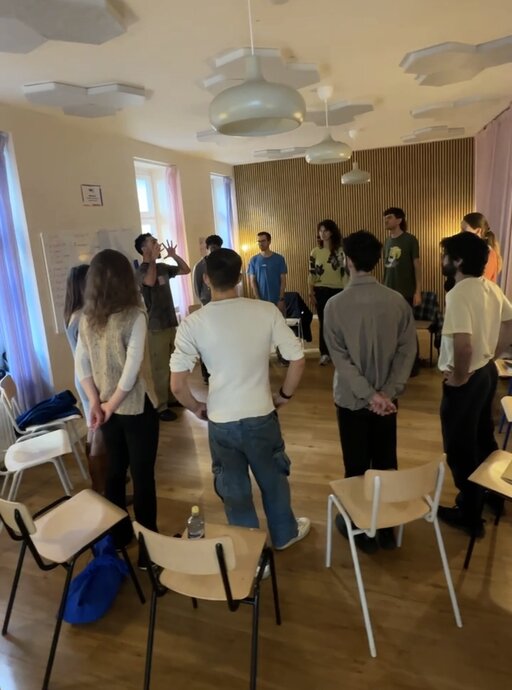
Role-playing is an experiential and physically embodied practice that allows participants to take on roles in fictional scenes and settings, engaging them in so-called “behavioural rehearsal.” By acting out intervention techniques, both the body and mind consciously and subconsciously remember them, which can surface embodied memories that remain beyond the magic circle of play—a phenomenon often referred to by role-play theorists as “procedural bleed,” where skills, reflexes, and modes of thinking developed during play carry over into a person’s everyday life [2, pp. 52, 68], [3, pp. 91, 95].
During civic courage training, participants put this rehearsal into practice by creatively exploring various third-party intervention techniques, such as disruption, distraction, body-blocking, amplification, affirmation, active listening, etc., in different fictional public, domestic, and private settings (e.g., the park, at home, or in the office). They build a personal and collective catalogue of action, and since these responses become mapped in the body, civic courage shifts from being an impulsive reaction to becoming an informed, conscious choice. The role-playing rehearsal allows participants to think back on and apply techniques they’ve already tried out when witnessing oppressive behaviour in real life.
In the words of Augusto Boal, drama pedagogue and author of Theatre of the Oppressed: “Maybe the theatre in itself is not revolutionary, but these theatrical forms are without a doubt a rehearsal of revolution” [4, p. 119].
3. Civic courage can be low-risk.
Risk assessment is one of the main reasons people don’t enact civic courage [1, p. 15]. Perhaps you are part of the targeted group yourself, putting you at direct risk. Maybe a clear size difference between you and an aggressive instigator creates a physical risk. Or you lack the formal social capital to speak up against a superior at work. People tend to weigh their contextual affordances (e.g., gender, race, stature, status, etc.), which in turn informs whether they act or not. The bystander effect (people’s disinclination to step in when others are around) and contextual ambiguity (e.g., unclear relationship dynamics or uncertainty whether a situation is serious or playful) contribute further to inaction. 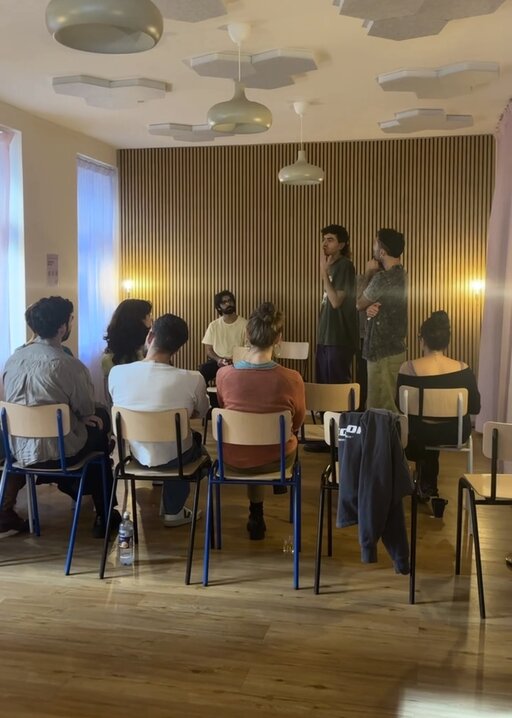
Without civic courage training, high-risk confrontational responses might be the only options that come to mind. But many low-risk techniques allow for effective interventions that are still safe. Acts of civic courage don’t always need to lead to transformational resolution to be meaningful.
What technique works best depends entirely on the situation. If someone else is being followed and catcalled on the street, intervening to explain why that is harassment could prove to be effective: a technique called “Focus on Instigator.” By interrupting the instigator, you not only create physical distance and draw attention from the target to yourself, but might also force the instigator to rethink their behavior. However, if the instigator is intoxicated or you suspect they might turn you into their new target, checking on the target, offering company, or acknowledging the inappropriate behavior can prove both safer and more effective: a technique known as “Focus on Target.” While the former carries higher-risk transformational potential, the latter carries lower-risk representational support. Both are acts of civic courage.
4. You’re most likely already doing it.
Without actively thinking about it, it’s likely you are already practicing civic courage in your everyday life, both proactively and reactively: when making sure everyone gets a turn to speak in a meeting, pointing out when someone gets interrupted, reminding a friend of a person’s preferred pronouns, or changing the subject at family dinner when an aunt is scrutinizing your cousin’s love life. These small acts all amount to larger personal, collective, and structural changes. You can try cataloging and naming the different intervention techniques you already use, and pretty soon, you’ll see that you already have a substantial bank of everyday strategies. Then, think about techniques you are less inclined to use and challenge yourself to try them out. They might prove very effective given the right context!
When we treat civic courage as ordinary, a skill that can be practised through role-play, and something that doesn’t have to involve risk or require heaps of bravery, we can more easily move from simply being witnesses of oppression to being its disruptors, consciously making every day a little more just.
Edwin Safari is a freelance performer and workshop facilitator with a background in Gender Studies and Transformative Role-Playing Game Design. They run Civic Courage Training workshops for workplaces, institutions, NGOs, and educational centers.